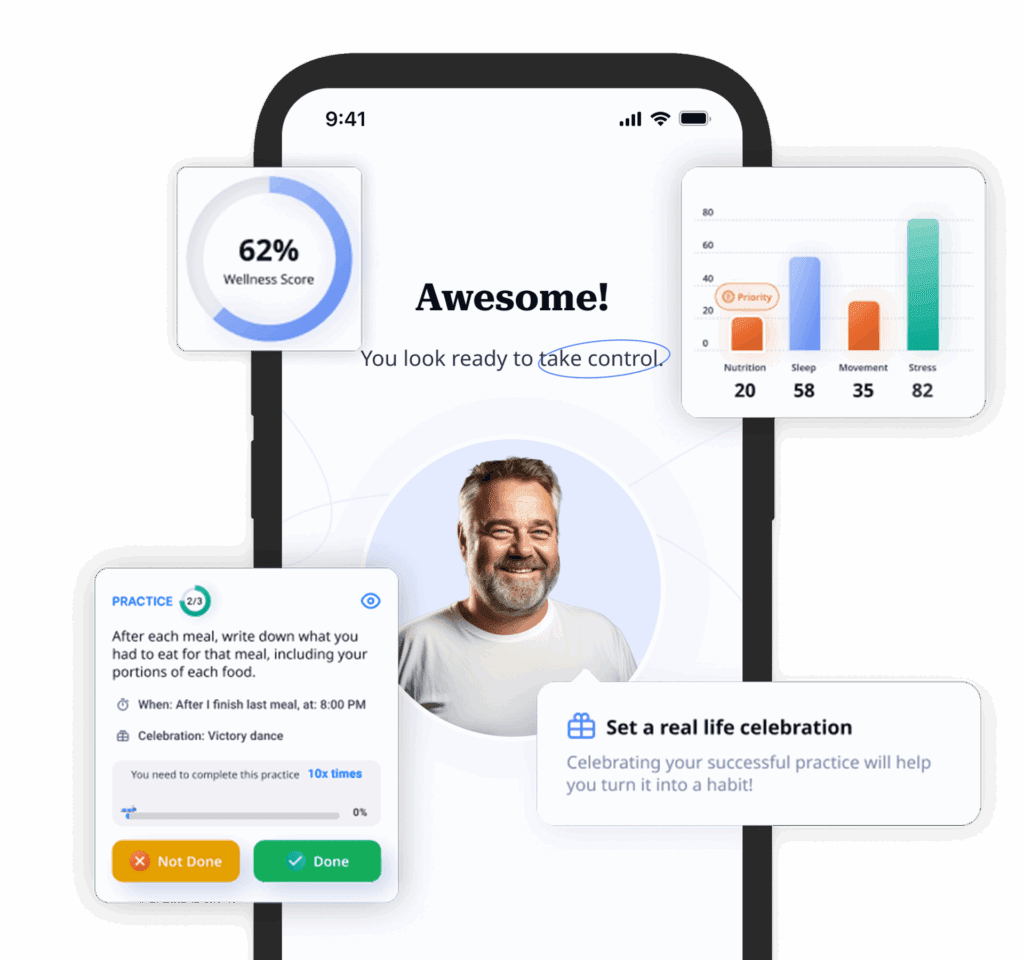
In this multi-part series we are are going to explore Sovi Health Habits Foundations Course. These modules are designed to give you the basics of habit formation. We then move to the Skills of Change spread across the 4 Pillars of Wellness:
Why is it that improving healthy habits is so difficult? We get a burst of motivation to change, make some progress, and then slip back into our old way of doing things when motivation wanes. Sounds familiar? The problem is that our habits and routines are deeply ingrained in our identity, and trying to change them without addressing the underlying identity can feel like trying to swim upstream.
Eating habits are especially troublesome because research has shown that people habitually consume food they do not want. Think about it. You are tired from a long day. You made a half-hearted attempt to eat a healthy dinner, and sit down to decompress in front of the television. The minute the TV turns on, all of a sudden you want your favorite salty or sweet snack, even though you are not hungry. It feels like you have no control over it because it’s a habit and it happens automatically.
What’s worse, those around us have an impact on us as well. Our family members, our friends, and our coworkers all impact our health decisions in different ways. Maybe it’s the birthday celebrations at work where there is always a cake. Or maybe you have a family tradition of celebrating certain events by getting together with a bunch of unhealthy (but delicious) meals. Our habits are already working against us, and these other social factors stack the deck even further.
We see the power of our habits already. And we know we want to change our habits to work for us to improve our health and not against us. But where do we start to ensure the changes we make stick and don’t get derailed by those around us?
As James Clear describes in Atomic Habits, a good starting point for reversing habits is to focus on identity-based outcomes. If you consider it for a moment it makes sense. If you focus on a particular goal first, like losing 20 lbs, once you achieve that goal you are finished. Yet you’ve done nothing to change who you are, which makes it easy to slip into your old patterns. “It’s hard to change your habits if you never change the underlying beliefs that led to your past behavior. You have a new goal and a new plan, but you haven’t changed who you are.”
When we focus on shifting our identity first, our behavior naturally follows. For example, if you see yourself as someone who values fitness and health, you will be much more likely to consistently make choices that align with that identity, such as going to the gym or choosing healthier food options. Instead of setting a goal to “lose 10 pounds,” we might set a goal to “become the kind of person who exercises regularly.” This shift in focus allows us to see our actions as expressions of our identity, rather than a means to an end. By aligning our actions with our values and beliefs, we can harness the power of our identity to drive long-term change. Once you’ve adopted the new identity, any behavior that does not match your new identity will have a hard time sticking around.
Another important aspect of identity-based behavior change is understanding that our identity is not fixed, but rather is constantly evolving. This means that we can always be working to improve and evolve who we are. Instead of seeing our past failures as evidence that we can’t change, we can see them as opportunities to learn and grow.
The behavior formula B = MAP, with motivation being an ingredient for making a behavior happen. This is a key element for making changes when things get tough. And they will get tough. Research has shown that the more you feel something as part of your identity, then the harder you will fight for it. You know what it feels like when someone challenges something you believe to your core. It stirs something in you. It is this motivation you access when you start your journey to better health by focusing on your identity, and it is this motivation that will keep you going.
Again from Atomic Habits, “The ultimate form of intrinsic motivation is when a habit becomes part of your identity. It’s one thing to say I’m the type of person who wants this. It’s something very different to say I’m the type of person who is this. The more pride you have in a particular aspect of your identity, the more motivated you will be to maintain the habits associated with it.”
This is also where your group identities come back in. Your new identity may not be congruent with those around you. And that’s OK. You will learn you can find groups to participate with (not to the exclusion of your friends, family, and coworkers in a corporate wellness setting ) that are in alignment with your new identity and that strengthen your identity based habits. So go ahead. Join a group that displays the behaviors you want to have as part of your identity. Buy a t-shirt that says you are a part of this group. Wear it with pride. In no time, you will start to see these new changes become a part of you.
Putting this work: Think about what identities you hold today. Are you a runner? A couch potato? A parent? Then think about who you want to become? An active person? An early riser? Someone who eats healthy foods? Relate that back to the behavior you identified in the initial workshop. Does that behavior support your new identity?
-The Sovi Health Team